Rules of the Game
This section describes how to play a game, a match, or a session of money games against GNU Backgammon or a human opponent. It is adapted from the rules section of Backgammon Galore, courtesy of Tom Keith.
Setup
Backgammon is a game for two players, played on a board consisting of twenty-four narrow triangles called points. The triangles alternate in color and are grouped into four quadrants of six triangles each. These quadrants are referred to as a player’s home board and outer board, and the opponent’s home and outer boards. The home and outer boards are separated by a ridge called the bar.
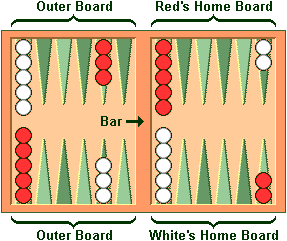
Figure 1. A board with the checkers in their initial position.
The points are numbered for each player starting from their home board. Each player has fifteen checkers. The starting position is: 2 checkers on the 24-point, 5 on the 13-point, 3 on the 8-point, and 5 on the 6-point.
Each player has their own pair of dice and a dice cup. A doubling cube (values: 2, 4, 8, 16, 32, 64) is used to track stakes.
Object of the Game
The goal is to move all checkers into your home board and bear them off before your opponent.
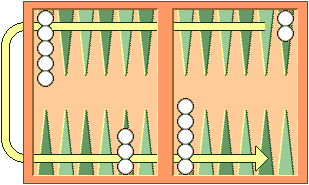
Figure 2. Direction of movement of White’s checkers. Red’s checkers move in the opposite direction.
Movement of the Checkers
To start, each player rolls a die. The higher roll goes first, using both dice values. Turns then alternate using two dice.
The roll indicates how many points a checker may move (forward only). Rules:
Checkers may move to open points (not occupied by two or more opposing checkers).
Dice values are separate moves. For example, a 5 and 3 roll can be two moves or one combined move if the intermediate point is open.
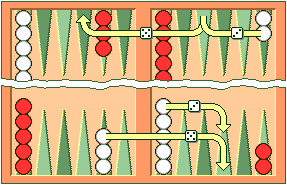
Figure 3. White opens the game with 5-3.
Doubles are played twice (e.g. 6-6 gives four 6-point moves).
A player must use both numbers if legally possible. If only one number is legal, the larger must be played.
Hitting and Entering
A single opposing checker (a blot) can be hit and sent to the bar. Barred checkers must re-enter before other moves.
Re-entry is done by placing the checker on a point in the opponent’s home board corresponding to a rolled number, if that point is open.
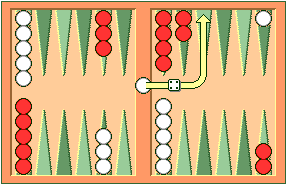
Figure 4. White rolls 6-4 with a checker on the bar.
If neither point is open, the player forfeits the turn. All checkers must be entered before continuing with other moves.
Bearing Off
When all checkers are in the home board, a player may bear off by rolling a die corresponding to the checker’s position.
If no checker is on that point, use a higher-numbered one. If none are available, the turn is forfeited unless another move is legal.
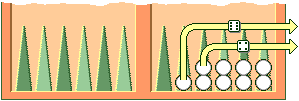
Figure 5. White rolls 6-4 and bears off two checkers.
A player must re-enter any hit checkers before continuing to bear off.
Doubling
Backgammon can be played for stakes. Each game begins with a value of 1. A player may propose doubling at the start of their turn.
The opponent may accept or concede.
The doubling cube passes to the acceptor, who alone may re-double.
There is no limit to redoubles.
Gammons and Backgammons
At game end:
If the loser has borne off at least one checker: they lose 1x the cube value.
If not: they are gammoned and lose 2x.
If not and they have checkers on the bar or opponent’s home board: they are backgammoned and lose 3x.
Optional Rules
Automatic Doubles: If doubles are rolled on the first turn, cube goes to 2. Usually limited to one per game.
Beavers: When doubled, a player may immediately redouble while retaining the cube.
Jacoby Rule: Gammons and backgammons count only as singles if no double was offered during the game.
Match Play
Matches are played to a point goal (e.g., first to 5). The Crawford rule prevents doubling in the first game after one player is within one point of winning the match.
Match to 5 |
White |
Black |
Doubling |
White wins 2 Black wins 1 White wins 2 Black wins 1 Black wins 2 White wins 2 |
2 2 4 4 4 6 |
0 1 1 2 4 4 |
Allowed Allowed Allowed Crawford Game Allowed Allowed |
There is no reward for winning by more than the required number of points.
Note: Automatic doubles, beavers, and the Jacoby rule are not used in match play.